
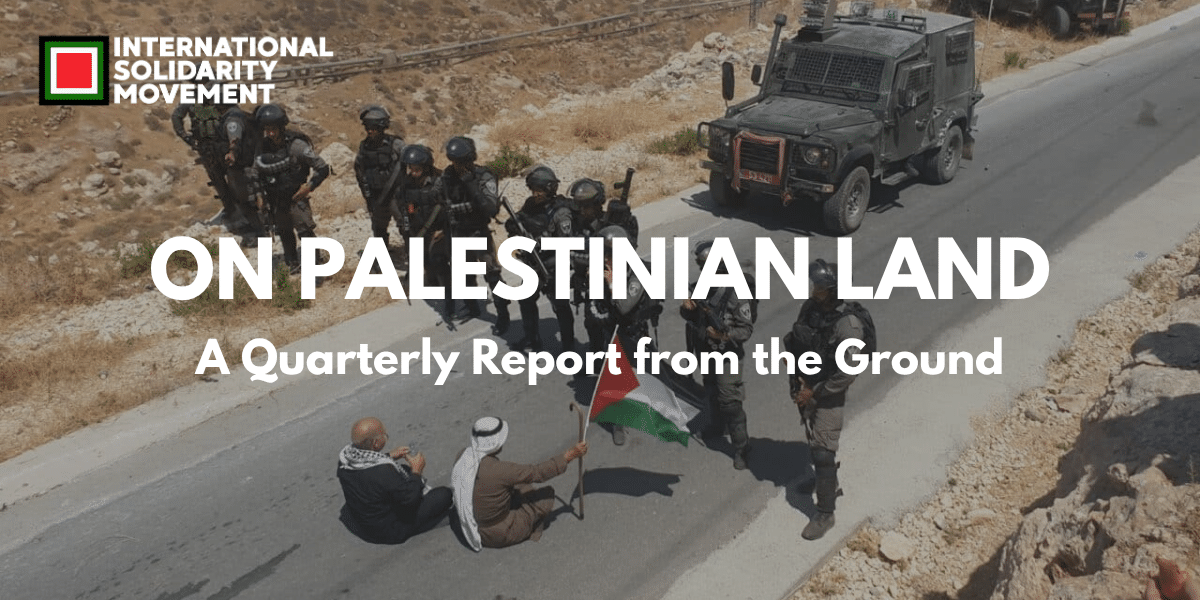
Welcome to the International Solidarity Movement Quarterly Newsletter! In the last quarter, assaults on Palestinian civilians, theft of crops and resources, and demolitions of homes have proliferated all across the West Bank. However, many updates often get buried due to repression of journalists and all eyes on Gaza. To combat this, every three months, we will share updates from the various areas across the West Bank where we have a presence.
Want to share this newsletter with your community? You can print more copies and distribute. For the print version, visit the following page: ISM Print Newsletter.
INTRODUCTION
To start 2026, after enjoying continual impunity while commiting genocide against Palestinains, the Israeli regime has expanded its scope. They extended the tactics of mass murder of civilians and mass destruction of civilian infrastructure they used in Gaza, into Lebanon and Iran, and brought their tactics of illegal occupation and de facto annexation from the West Bank into Syria and Lebanon.
In Palestine, the colonial regime has brought an onslaught of tactics aimed at ethnically cleansing indigenous people. In addition to the state-supported campaign of settler terror in the West Bank, some of which is detailed in this report, settler organizations and state authorities displaced families in Occupied East Jerusalem through forced evictions (read more: Global Protection Cluster). In Gaza, Israel continues its genocidal blockade and bombardment, killing dozens and injuring hundreds of people in the first weeks of the year alone (see also: UN Situation Report 66). Across Palestine, the occupation forces continue to kidnap Palestinians and now, Palestinian prisoners face a politicised and discriminatory death penalty law in addition to enduring systemic torture (see also: UN Special Rapporteur).
JORDAN VALLEY
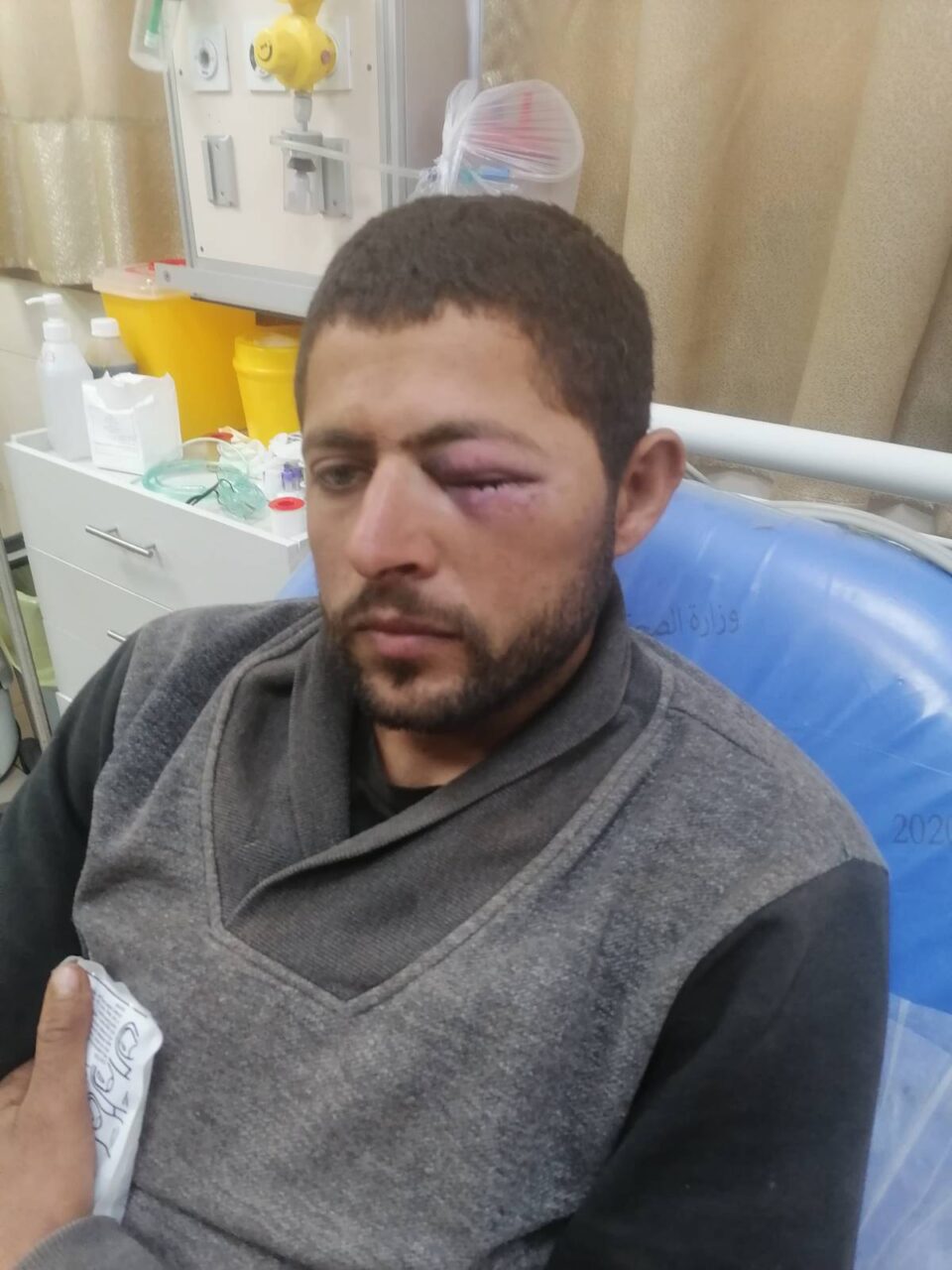
Violence and displacement in Hammamat Al Maleh exemplify Israeli settler and military collaboration in ethnic cleansing
On December 27, 2025 Israeli settlers carried out a violent attack against the Daragmeh family, beating their 12 year old daughter and two grandchildren. As more settlers joined in the raid, they began vandalizing multiple family homes in the area and assaulting Palestinian women. Israeli soldiers blocked an ambulance from reaching the injured children, and then arrested four Palestinians from the Daragmeh family. The settlers, who also stole 6 sheep, 5,500 shekels, and 5 cellphones from Daragmeh family, faced no consequences for their crimes, which is a common outcome when settlers assault Palestinians. Read more on this incident here: ISM.
Less than two months later, On February 2, 2026, ten soldiers once again attacked the Daragmeh family. After zip-tying the family members’ hands and forcing them to kneel against a wall, they ransacked the house, confiscating ID’s from both Palestinians and internationals. See more about this attack on our Instagram: ISM Instagram.
After months of violent attacks from both Israeli settlers and military, the Daragmeh family were forcibly displaced from their home. Hammamat Al Maleh is located in a part of the Jordan Valley where Israeli occupation forces have begun building an apartheid wall that will sever the northern Jordan Valley. (Read more on this here: ISM) Mass displacement of Palestinians in these locations due to violent, unabated settler attacks demonstrates how the Israeli government uses both settlers and soldiers to carry out the ethnic cleansing of Palestinian land.
The Hammamat Al Miteh, Al Burj, and Ein El Hilweh Communities Face Relentless Attacks, resulting in mass displacement
Throughout January 2026, there were multiple instances of armed Israeli settlers grazing their cows on Palestinian land in Hammamat Al Miteh and Al Burj (which is also located in the area intended for the Israeli occupation forces’ new apartheid wall). While grazing their cows, Israeli settlers damaged property, taunted family members, and threatened to steal Palestinian livestock. During one of these encounters, settlers physically assaulted a family in Al Miteh while Israeli soldiers watched and did nothing to stop the assault. Read more about this here: ISM
On February 8, 2026, the Israeli military demolished housing structures in both Hammamat Al Miteh and Ein Al Hilwe (interview:Instagram). Days later, on the 15th of February, settlers burnt tents belonging to Palestinians in Al Miteh. The settlers also destroyed a security camera and the internet wire leaving the families in the area without internet access or phone signal. Read more on this here: ISM
The remaining families in Al Miteh were also forcibly displaced in February as a result of the violence.
Demolition and Displacement in Fasayel Al Wusta and Ras Ein Al Auja
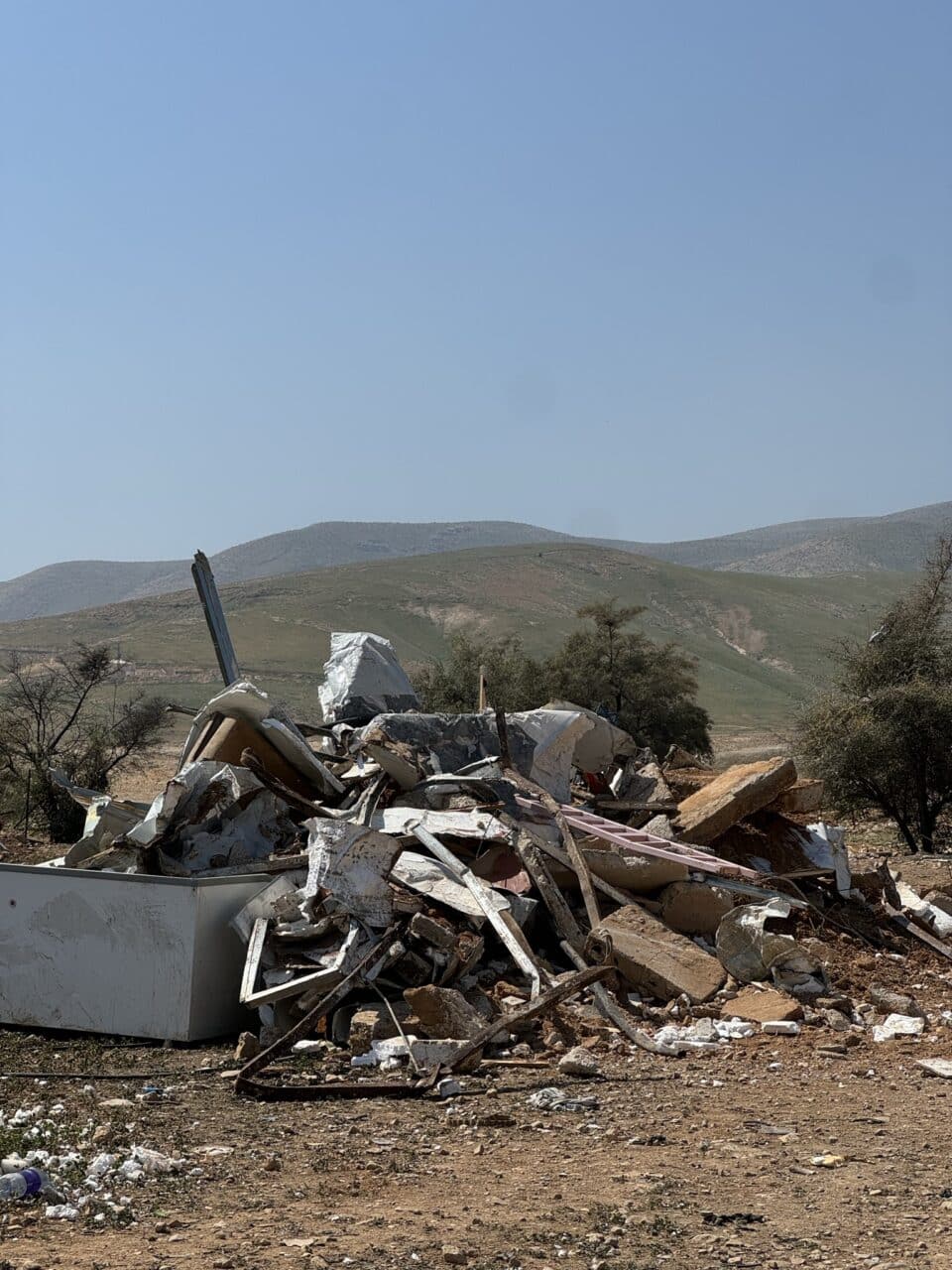
Israeli settlers dumped a truckload of rotten dates onto the property of a Palestinian family in Fasayel Al Wusta on January 15, 2026. This incident was succeeded by weeks of settlers trespassing onto the property and harassing the family. The leader of these settlers was Eilav Libi, co-director of Libi Construction and Infrastructure, a company contracted by the Israeli government to bulldoze homes in Gaza. See more: Instagram
On the 23rd of February, Israeli settlers cut off water and electricity access to the family and then setup a new outpost (which is illegal even under Israeli law) next to the family’s home. See more: Instagram
On the morning of March 16, 2026 the Israeli army, settler security, and border police demolished the family’s home in Fasayel Al Wusta. The family had lived there for 20 years. Israeli bulldozers arrived one day earlier than the deadline Israeli authorities had given to the family, and told the family they had to pay a fine of more than $25,000 for the destruction of their own home. The bulldozers encircled the home and left the family little time to gather their things and leave. International activists present were ordered to leave the area immediately and threatened with deportation if they did not comply.
This family was one of the last remaining steadfast on the land in Fasayel al Wusta. Read more about the displacement here: ISM
Over 100 families in Ras Ein Al Auja, the largest shepherding community in the West Bank, were forcibly displaced by mid January following years of uninhibited settler violence. This included settlers occupying a new outpost just a few dozen meters from people’s homes, which they used as a base to attack people, set Palestinian’s property on fire and steal from the community. See photo set here: Instagram
Families Remain Steadfast in Khirbet Samra Despite Israeli Settler and Military Intimidation
Israeli settlers established a new outpost on a hill adjacent to three family homes in Khirbet Samra on 1 February. The families, comprised of three brothers and their wives and children, are the final remaining Palestinians in Khirbet Samra, which means they have been enduring mounting pressure from settlers and soldiers working together to displace them. The family patriarch, Abd Daraghmeh, was born in Samra in 1938 and has lived there all his life.
The new outpost facilitates daily surveillance and harassment from settlers. On February 6, settlers called the Israeli military to block the delivery of a new toilet stall to Samra. Two days later, Israeli “agents of nature” informed the family that if their dogs were seen without a collar they would be shot and killed. The dogs serve important roles like keep the families alert to settlers trespassing, stealing, and damaging property. On February 10, settlers descended from the outpost and confronted the family near their sheep pen, injuring several Palestinians in attacks with pepper spray. The injured Palestinians were taken to a nearby hospital and treated for burning eyes and faces.
On 26 February, settlers from the outpost called the military on Samra residents, leading to the arrest of one family member who was released shortly after without charge. See our reel: ISM Instagram
Read a report about Samra here: ISM
One of the families made the decision to leave with its flock following repeated harassment and threats from settlers illegally residing in the outpost.
Sexual Violence as a Weapon of Ethnic Cleansing in Khirbet Humsa
Around 1:20am on 12 March 2026, 30 Israeli settlers savagely attacked a Palestinian family in Khirbet Humsa, as well as two international actvists staying with them. All 12 members of the family, including young children and their mothers, were beaten along with the international activists. One of the men was sexually assaulted, and another man from the family has suffered psychological disturbances after being beaten on the head with a rock. Another man, after injuries to his leg, now requires a cane for walking support. The man who was sexually assaulted is still undergoing treatment to his eye and genital area. See the reel with Qusai Abu Al-Kabesh’s story from the attack here: Instagram
During the attack, the settlers opened the family’s sheep pen, letting loose around 350 of their sheep. They also stole wallets, passports, and phones from the two international activists. Some of the family’s valuables, including cash, jewellery and documents were also stolen. Read more about this: ISM
The shocking and disturbing nature of this attack follows decades of documented accounts of Israelis using sexual violence to terrorize Palestinians in an attempt to drive them from their homes.
The harassment continued two weeks later, when settlers drove their all-terrain vehicle (ATV) into a flock of grazing sheep owned by a neighboring Palestinian family in Khirbet Humsa on 31 March – see: Instagram
Settlers have continued trespassing on the property, driving in their ATVs and threatening the family with imminent attacks.
Tubas, Tammoun, Ein Al Beida, and Bardala Suffer as a Result of the Israeli Military’s Construction of a New Apartheid Wall
On January 26, 2026, Israeli settlers attempted to steal a truck full of building materials from a family home in Ein Al Beida. They were intercepted by Palestinians and activists, who forced them to return their stolen goods. See reel here: ISM Instagram
Israeli forces demolished a home under construction in Ein Al Beida on February 19, just ten days after informing the family of demolition orders. Read more here: ISM Instagram
On 22 February 2026, a group of Israeli settlers assaulted a Palestinian family in their home in the village of Bardala, near Ain Al Beida. The settlers beat a husband and wife in front of their children, and the two Palestinians were arrested when the Israeli military arrived. Three days later, Israeli forces arrested a vegetable stand owner in Bardala for allegedly operating without a proper permit, and distributed 10 demolition orders to vegetable stand and greenhouse owners in the village. The devastation of this displacement is explained with photos here: ISM Instagram. Read more here: ISM and here: Instagram
On March 14, Israeli special forces in Tammoun, southeast of Tubas, disguised themselves in a Palestinian civilian vehicle and opened fire on the Odeh family. Four family members were martyred, including the father, mother, and two of their children, while two surviving children were harassed by the soldiers before being taken to a hospital in Tubas by the Palestinan Red Crescent. Read more here: Instagram
On March 25, Israeli forces stormed the villages of Tubas and Tammoun, assaulting and hospitalizing three Palestinians and arresting ten others. They distributed leaflets to residents in the villages threatening to arrest and kill anyone they suspect of terrorism; read more here: Instagram
On March 26, settlers viciously attacked Palestinian farmer Abdallah Alghori in Tayasir, near Tubas. Settlers stole his sheep and opened fire at Palestinians who tried to stop them, injuring seven Palestinians. For more coverage (content warning: graphic), see: Jordan Valley Solidarity
The increasing Israeli military and settler violence in these areas must be seen within the larger context of the new apartheid wall that Israeli occupation forces started building in March in the northern Jordan Valley. Read more about this annexation wall here: ISM
Khirbet Yarza, Duma, Ein Al Duyuk, Al Hadidya, and Khirbet Tal al Himma Residents Harassed by Settlers, then Arrested by the Military
Two Israeli settlers harassed a family in Duma on January 10 for several hours in the night and the following day. The settlers damaged property, played loud music, tried to set a fire, threatened to pull their guns on the family and activists, and allowed their goats to graze all over the property. They especially targeted the family’s children, between the ages of 3 and 10, with intimidation and harassment. Israeli police refused to address the incident, despite being called mulitple times. See our reel: ISM Instagram
On January 29 in Ein Al Duyuk, west of Ariha (Jericho), six Israeli settlers, including two children, trespassed onto family property. One settler was armed and drinking a beer and threatened to run over Palestinians and international activists. He then urinated in front of them before driving away. See our reel: ISM Instagram
Families in Al Hadidya live under constant terror from Israeli settlers, and on January 28, multiple settlers on ATVs invaded a family’s property. The settlers were armed and verbally assaulted the Palestinians until the military arrived and arrested three of the Palestinians. Those arrested reported hours of torture, including being blindfolded, bound, dragged, left outside in the rain for around six hours, verbally abused, and forced to sit next to a speaker system blaring the sounds of dogs barking. At least one individual was strangled until losing consciousness. They were eventually released, with one Palestinian being forced to pay a 2,000 shekel fine. See the settlers here: Instagram . Six settlers attacked the family again on March 1, resulting in the arrest of seven Palestinians who were attempting to defend themselves. The Palestinians were all released several hours later. See residents’ footage here: Instagram
On 23 February, settlers attacked the residents of Khirbet Yarza, beating several shepherds. After the assault, the settlers stole a knife from one of the Palestinians and used it to stab his horse. Read more here: Instagram. A month later, on 24 March, the Israeli military established a temporary checkpoint in Khirbet Yarza, to inspect and intimidate Palestinians leaving and entering Tubas. Israeli soldiers severely beat a Palestinian man at the checkpoint, hospitalizing him. See our detailed coverage here: ISM Instagran
An armed settler attacked Palestinian shepherds in Khirbet Tal al Himma on 27 February, resulting in the arrest of four Palestinians. See footage of the settler here: Instagram. The settler who attacked the shepherds never faced any consequences. Settlers are rarely ever reprimaded for assaulting Palestinians, while Palestinian men, women, and children are routinely arrested by the Israeli military after being victims of violence.
MASAFER YATTA
Mass Attacks in Various Locations, Coordinated by Israeli Military and Settlers
On January 6, 2026, settlers trespassed on Palestinian land in Haribat al-Nabi, grazing their sheep on the family’s property. When the police were called, soldiers showed up and arrested the Palestinians, which allowed the settlers to continue trespassing on their property. Hours later in the village of Tuba, another settler grazed his flock near a group of Palestinian shepherds and attempted to steal sheep from them. When the Palestinians stopped him, the settler called the police. The police arrested a fourteen-year-old Palestinian shepherd, while again, the settler who attempted theft faced no consequences. The boy was released a few hours later. Around the same time, soldiers raided the village of Dqeiqeh and arrested a Palestinian man in his own home without providing any explanation. See a reel about the incident here: Instagram
Settlers use sheep grazing on Palestinian land as a means of destroying property and intimidating families. On January 8, settlers on donkeys invaded a Palestinian family home and stole belongings of international activists staying there, while throwing rocks at elderly residents. See our reel: ISM Instagram. (This post does not provide location details.)
On the evening of January 27, 100 settlers set fire to multiple family homes across various locations in Massafer Yatta in a coordinated attack. After burning animal feed, stealing livestock, and assaulting several residents, they blocked ambulances from reaching the injured. Footage from the scene: Instagram
Beginning around 2pm on March 23 and lasting until midnight the following day, Israeli soldiers and settlers launched a campaign of terror across various villages in Masafer Yatta. The Israeli army and settlers raided the villages of Mnezel, Tuwani, Rojum Ali, Um Durit, Khalat Al Mfatih, Um al Khair, and Haribat al Nabi. As a result of coordinated Israeli military and settler violence in Khalat Al Mfatih, during which settlers assaulted residents and Israeli police and army fired tear gas, stun grenades, and live rounds, and then allowed the settlers to steal 70 sheep, the family made the heartbreaking decision to leave their home. More on this here: Instagram
Settler Terror in Al Fakheit
Settlers used sticks to beat an elderly man, his wife, and their daughters on the evening of January 27, hospitalizing both the man and wife. Footage (graphic): ISM
Less than a month later, on February 24, settlers returned to Al Fakheit and slashed a family’s water pipes, leaving an entire community without access to water. Israeli terror often involves depriving Palestinians of their right to water. Reel: Instagram
While grazing their flock of sheep near Al Fakheit, two Palestinian shepherds were brutally bludgeoned by Israeli settlers, who had unsuccessfuly tried to steal their sheep – see our reel here: ISM Instagram. An elderly Palestinian man was left bleeding from his head. See also: Instagram
Rakeez Suffers Settler and Military Assault
On February 27, settlers bulldozed olive groves on land belonging to Sheik Saeed’s family. They harassed family members, throwing Sheik Saeed, who had lost a leg in 2025 after being shot by a settler, to the ground with a camera pole. They then established a camera on the property to surveil the family. See our reel here: ISM Instagram
The settlers returned weeks later on March 15 to attack Sheikh Saeed again, shoving him to the ground, pelting him with stones, and pepper spraying a neighbor who attempted to intervene on the attack. Settlers called the military and nine soldiers arrived later, assaulting Sheikh Saeed with a stun grenade and hitting him in the head with a rifle, hospitalizing him. See footage here (warning: graphic): Instagram
Settlers Set Homes on Fire in Susya and Halawe


On the evening of February 24, settlers trespassed in a vehicle with Palestinian license plates and entered the village of Susya. Settlers hurled explosives towards a family home while its residents were present, burning the family’s fence. Settlers then set fire to a truck, a tent families sleep in, and the stolen vehicle. More information here: Instagram
On March 11, settlers set fire to two homes in Halawe and cut water pipelines. See more here: Instagram When the military arrived, settlers blamed Palestinians for the fires, and the soldiers believed them.
These terror attacks occur daily all over Masafer Yatta in an attempt to drive Palestinians from their homes and allow the Israeli government and military to seize more land.
Settler and Military Collaboration in Um Al Kheir
Palestinians in Um Al Kheir, where a settler shot and killed activist Awda Hathaleen in July of last year (see: ISM), have been busy building a football pitch as a respite from relentless violence. Settlers from the nearby “Carmel” settlement have been harassing workers building the football pitch, and on February 11, the Israeli military issued a stop-work order. The work that has been completed so far is now under threat of demolition. See instagram post here: Instagram
Israeli settlers fired live bullets at Palestinian vehicles in Um Al Kheir on March 25, causing several vehicles to veer off the road. One Palestinian man, Yusry Amy Qbeita, was martyred as a result. Health workers attempting to reach the injured were fired at as well, hospitalizing mulitple Palestinians with serious injuries. See footage here: Instagram
Horrific Violence in Rojumm Ali
Around 7am on March 25, a settler brought his sheep to graze on Palestinian land. The Israeli army arrived later, spoke with the settler for a few minutes, and then watched as the settler violently harassed the Palestinians present, even throwing an elderly man to the ground. Shockingly, the military then launched an attack against the Palestinian victims of the settler attack, throwing tear gas and stun grenades at them. They arrested two Palestinians, while an armed settler attempted to uproot olive saplings. Soldiers continued firing tear gas at the shepherding family, and when members of the community tried to assist the injured, soldiers shot live bullets in their direction.
In total, two Palestinians were arrested and taken away, seven detained on site, and two were injured and taken to the hospital. The attack, which lasted for hours and began with a single settler trespassing on Palestinian land, exemplifies the collaboration between settlers and soldiers escalating violence against Palestinians. See footage here: Instagram
Harassment and Confrontation in Zweiden and Mnezel
On December 29, settlers arrived in Zweiden to harass Palestinian families. They shoved two international activists and punched them in the testicles. The settlers spent the next half hour driving around the family’s property and threatening to enter before withdrawing back to the settlement. See: Instagram
While settlers trespassed on Palestinian land on the morning of February 6 in Mnezel soldiers harassed Palestinian women and children. The women refused to back down, confronting the soldiers and remaining steadfast on their land. Soldiers fired stun grenades at their sheep, ignoring settlers harassing them, and then left. See also: Instagram
Military and Settlers Work Together in Ghwein, Kharaba, Isfey At-Tahta, and Um Durit
Settlers attempting to steal sheep let their dogs attack Palestinian children on February 7 in Ghwein. They returned later and cut the cables to security cameras. When the family called the police, Israeli soldiers arrived instead and detained international activists for several hours. See more: Instagram
Settlers fired bullets at Palestinian shepherds and their flocks on February 25 in Kharaba, then called settler militia to raid the village. With drones flying overhead, soldiers zip tied two Palestinian men and blindfolded them. They held them in the sun for hours before releasing them without arrest. For more: Instagram
On February 28, masked settlers fired live bullets at Palestinians in Isfey At-Tahta, hospitalizing one. When the army arrived, they arrested several Palestinians and the settlers faced no consequences for their violent attack.
Israeli soldiers invaded a Palestinian home on March 25 in Um Durit, cutting the cables to the family’s security camera, threatening the family, and interrogating international activists. Settlers showed up hours later to harass the family and pepper sprayed a Palestinian woman in the face. When Israeli police arrived on the scene, they did nothing but mock the woman who had been attacked and then left.
Settlers Martyr a Palestinian Man in Wadi Rakhim
On March 6, settlers shot and killed Amir Mohammad Shenran (28) and wounded his brother Khaled. Amir’s funeral was held the following day in Yatta. After the shooting and during the funeral, the Israeli military drove bulldozers around the village, causing residents to worry that their homes would suddenly be demolished. Settler violence and military harassment are a daily struggle in villages all over the West Bank. See more: Instagram
AL-MUGHAYYIR
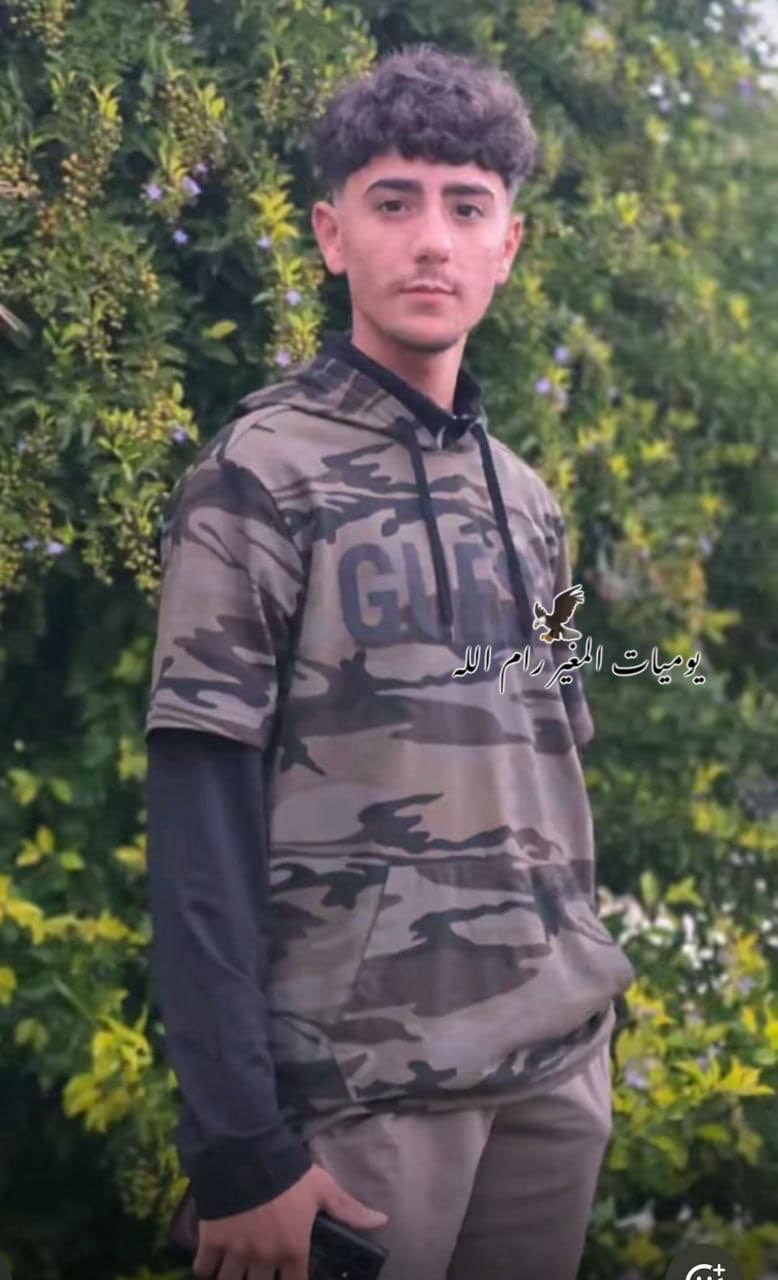
The Last Remaining Families Forced to Flee After Facing Near Fatal Settler Attacks Aided by Military
On December 30, 2025 three international activists were surrounded, thrown to the ground, handcuffed, and forcibly taken from the Abu Naim family home in Al Khalayel, on the outskirts of Al Mughayyir village. They were held for 12 hours at a military base, without being traceable, before being transfered to a police station.
On January 16, 2026, Israeli forces raided the Abu Naim family home for three hours, disabling security cameras and preventing the family and the four internationals with them from eating. The four internationals were eventually arrested under false accusations of assaulting a minor and violating public peace. Two of the activists were ultimately released from custody with bans from entering the west bank (as described here: 972 Mag), while two other activists were later deported (see more information here: ISM). On the same night, Israeli forces raided the village of Al Mughayyir and shot and killed 14-year-old Muhammad Saad Sami Naasan outside of the village mosque right after evening prayer. See more information on this here: ISM.
On January 17, 2026, 37-year-old Hadaya Abu Naim was arrested for alleged stone throwing, despite video evidence proving her innocence. Hadaya had been driving into Al Khalayel to meet her relatives when a teenage Israeli settler from the illegal Chivat Shlisha outpost blocked her vehicle. When Israeli forces arrived to arrest Hadaya Abu Naim, they demanded that anyone not related to the family leave, removing the international activists from the property and arresting a solidarity activist from Jerusalem (see more information here: ISM). Hadaya Abu Naim was released a few days later.
On Feb 1, 2026, Israeli forces raided the Abu Naim family home again, this time arresting three international activists after presenting a one-day closed military order. One of the activists was let out of the military vehicle on the side of the road, where he was harassed by Israeli settlers. The remaining two activists, both French citizens, were taken to Shaar Binyamin police station, where they had a visa revocation hearing. Both decided to resist deportation and await trail at the Ben Gurion detention center (more information here: ISM), but were ultimately deported after an Israeli judge delcared that being in a “sensitive area” is enough to warrant deportation (as described here: ISM).
On February 8, 2026, just days after the Israeli military raid in Al Khalayel, 100 Israeli soldiers raided Al Mughayyir. Late in the evening, Israeli soldiers raided Palestinian homes, destroying private property, and beating residents (read more on this here: ISM).
On February 17, 2026, Israeli soldiers raided the Abu Najeh family in Al Khalayel to arrest three men they falsely accused of stone throwing. The soldiers broke the family’s security cameras, and beat and arrested 55-year-old Mustafa Omari for filming illegal settlers. He was released the following morning. The escalation in violence led the Abu Najeh family to make the devastating choice to flee their home in Al Khalayel.
While the Abu Najeh family were packing their belongings on February 21, multiple settlers came to harass the Abu Naim family throughout the day, culminating in a violent attack during which 12 settlers broke into their home and beat Hidaya Abu Naim, her 70-year-old father Rizq Abu Naim, and her 13-year-old daughter Ilham Wadi Abu Naim. When international activists and Al Mughayyir residents attempted to reach the Abu Naim family and protect them from the settlers, Israeli soldiers and settlers fired tear gas and live bullets in their direction, shooting 36-year-old Ayham Abu Naim in the back and his 13-year-old nephew, Naseem Shaker Thabta, in the foot.
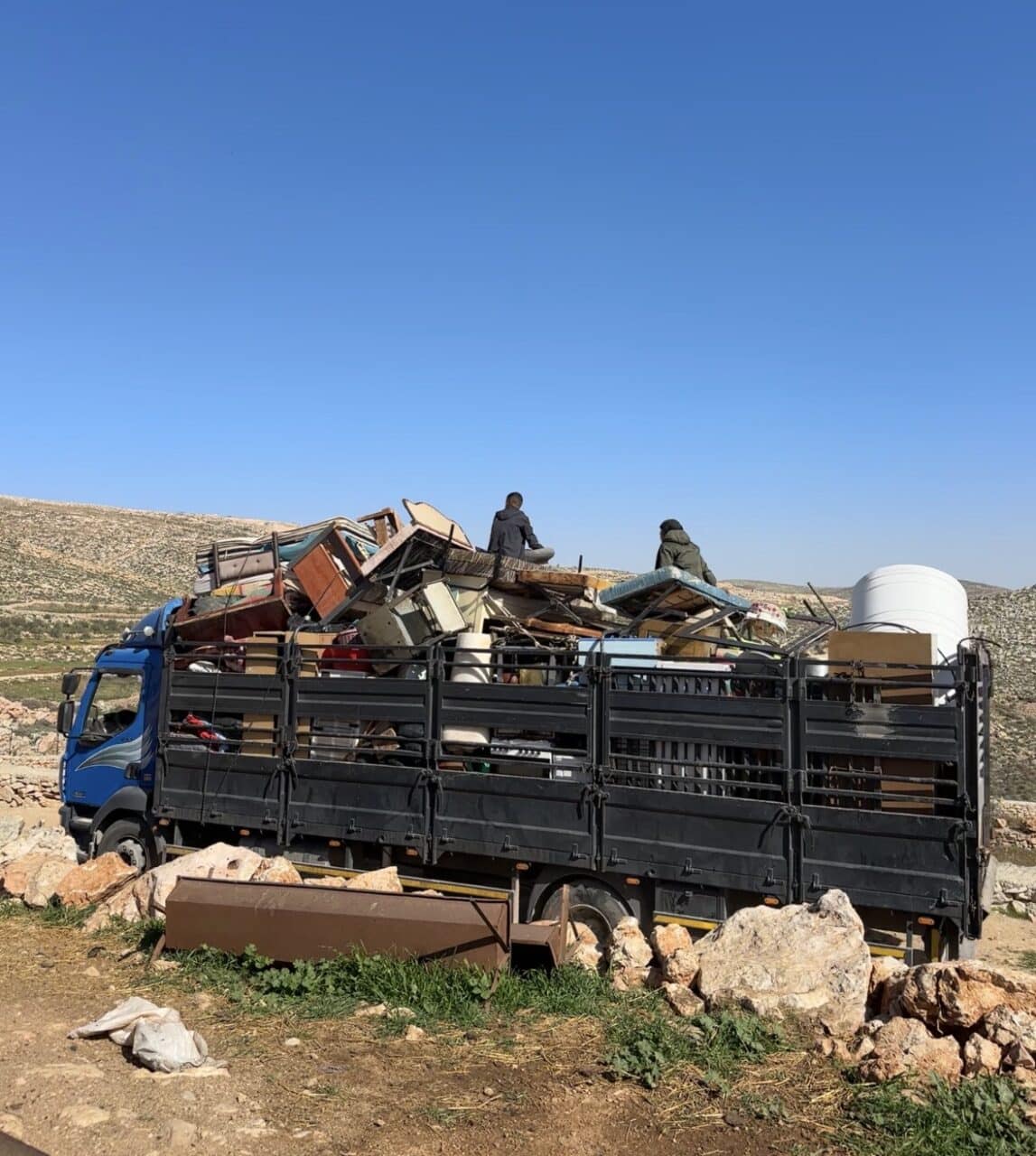
On February 22, 2026, the final two families in Al Khalayel gathered their belongings and fled their homes after months of relentless violence from settlers and soldiers (read more about this here: ISM). The New York Times covered this historic and devestating displacement in this article: NYT.
By March 16, 2026, settlers had already established a new outpost in Al Khalayel, as shown here: Instagram.
The same day (March 16), Israeli forces detained several Palestinian men at the entrance to Al Mughayyir town, forcing them to undress publicly while searching them.
On March 30, 2026, Israeli soldiers established a temportary checkpoint around 6pm at the entrance to Al Mughayyir, blocking residents from entering and exiting. The checkpoint remained until 10pm, after which some vehicles entering the village were stopped and inspected. During one of these inspections, Israeli soldiers stole money from an Al Mughayyir resident. See here: Instagram
RESISTANCE ACROSS PALESTINE
Al Khalil (Hebron): Israel Bars Palestinian Muslims from Worshiping in their Mosques at Ramadan
Ramadan, which occured in February and March this year, is the holiest month for Muslims. Nearly 98% of the 5.5 million Palestinians in the West Bank identify as Muslim. Israel has used chaos and media attention surrounding the US-Israel war against Iran as cover for escalation in the West Bank, including shuttering access to Muslim holy sites and mosques, like Al Aqsa in Al Quds (Jerusalem) and Ibrahimi mosque in Al Khalil (Hebron). Palestinians travel, often on foot, several kilometers to observe Friday prayers at Ibrahimi mosque, only to be denied entry by the Israeli military. Read more here: ISM. See also: Instagram
Tulkarm
On 2 January 2026, the Israeli army destroyed 25 multi-story buildings belonging to Palestinian families in Nur Shams camp. Our interview with a Palestinian whose home was destroyed can be viewed here: ISM Instagram. You can also hear more from Palestinian women protesting being displaced from their homes in Nur Shams here: ISM Instagram
Residents of the city of Tulkarm, particularly refugees from the Tulkarm and Nur Shams camps, are enduring extremely difficult humanitarian conditions after a displacement that has lasted more than 16 months and continues to this day. Israeli occupation forces remain present inside the camps, having turned dozens of Palestinian homes into military outposts. Daily arrest raids are still being carried out across various areas and surrounding villages in Tulkarm.
Israel has once again failed to uphold its announced decisions. Israeli authorities had declared that Palestinian refugees would be allowed to return to their homes in both camps by the end of January 2026. However, the deadline was then extended to the end of March 2026, and this promise was not fulfilled. The return was then postponed again to the end of May. Palestinians, however, have little confidence in these timelines and continue to live in a state of fear and uncertainty.
In addition, settler attacks against Palestinians continue intermittently in nearby villages around Tulkarm, such as the village of Ramin. The residents of Tulkarm, especially those in the refugee camps, feel deep disappointment. However, they remain steadfast in their belief in God’s justice, trusting that it will prevail, even if it takes time.
Jenin
Last year, in an escalated campaign including the “Operation Iron Wall,” the Israeli army forcibly displaced around 16,600 to 20,000 Palestinians from their homes in the Jenin refugee camp. Israeli soldiers threatened to kill people if they did not leave, yet harassed and interrogated people when they did. Many Palestinians are now living in the American University in the town of Zababdeh, where they continue to be harassed by the Israeli army through surveillance and raids.
The Israeli army destroyed people’s homes and infrastructure, and the Israeli authorities have said that they will not permit rebuilding of demolished residential buildings, so many people will have nothing to return to. Nonetheless, over a year later, the Israeli occupation forces are still preventing families from returning to their homes, and the camps remain under military siege with the army still stationed inside.
Across Jenin, the Israeli army and settlers continue to demolish and destroy olive trees, shops and houses and displace people from their homes. On March 29, 2026, the Palestinian news and information agency WAFA reported that the Israeli army uprooted dozens of olive trees in the town of Arraba, south of Jenin, using bulldozers. On March 21, 2026, WAFA reported that settlers targeted several homes, attempted to set them on fire, and physically assaulted a resident. The occupation forces are also storming towns and villages and seizing land. On March 13, 2026, WAFA reported that 133 dunums of Palestinian residents’ land in the governorates of Jenin and Salfit were confiscated under the pretext of “military purposes.” As well as attacking homes and livelihoods, occupation forces continue to interrogate, arrest and assault Palestinians across the area using live ammunition and beatings.
Deir Sharaf
On November 11th, 2025, a mob of 100 illegal Israeli settlers descended upon the small Palestinian village of Deir Sharaf, in the northern West Bank. During the attack, the mob firebombed vehicles, invaded and destroyed family homes, and severely injured Palestinian residents. The settler beating was so brutal that one Palestinian was left with a fractured skull and brain hemorrhaging, leaving him in a coma. Since the settler attack, four of the five families in the village have left. For more: Instagram
Silwan
On the 30th of December 2025 the Israeli occupying forces demolished a palestinian family home in the area of Silwan in the Al Bustan neighbourhood in occupied East Jerusalem. Around 200 occupation soldiers secured the surrounding streets and set 50 soldiers and bobcats to tear through the house, leaving it in rubble and a Palestinian family without a home. The demolition is part of the colonial project that began in 2004, occupying and destroying life house by house. Demolitions are ongoing not only in the Bustan neighborhood, but in every part of East Jerusalem: Silwan, al – Issawiya, al – Tur, Shuafat, Beit Hanina, Sur Naher, and further villages are subjected to demolition, confiscation and exodus. See more: Instagram
The Israeli army detained two Palestinians during a raid on Al Bustan neighborhood in Silwan village, in the occupied city of Jerusalem. See also: Instagram
Qaryout
March 2 2026, Qaryout, south of Nablus—Israeli settlers invaded the land around the village, bulldozed the olive groves, raided the village and fatally shot two Palestinian brothers, Mohammed (52) and Fahim (48) Mu’amer. They shot another person in the head and injured at least nine others. Settlers also set fire to several cars and raided homes. When the army arrived, they threw tear gas on residents and detained around 20 people. Ambulances were prevented to reach the injured for over an hour. Then various area of the village were put under curfew. See our reel: Instagram.
Deadly Wave of Attacks
In a surge in violence, Israeli settlers killed six Palestinians between February 28 and March 10, after the US and Israel attacked Iran. Brothers Mohammed (52) and Fahim (48) Mu’amer were killed in Qaryout. Colonial settlers killed Amir Mohammed Shnaran (28), and seriously injured his brother Khaled Shnaran (33) in Masafer Yatta. Thaer Farouq Hamayel (24) and Farea Jawdat Hamayel (57) were shot in the head in Abu Falah, and Mohammed Hassan Murra (55) died from tear gas inhalation after an attack by the Israeli army. Read more here: ISM Instagram
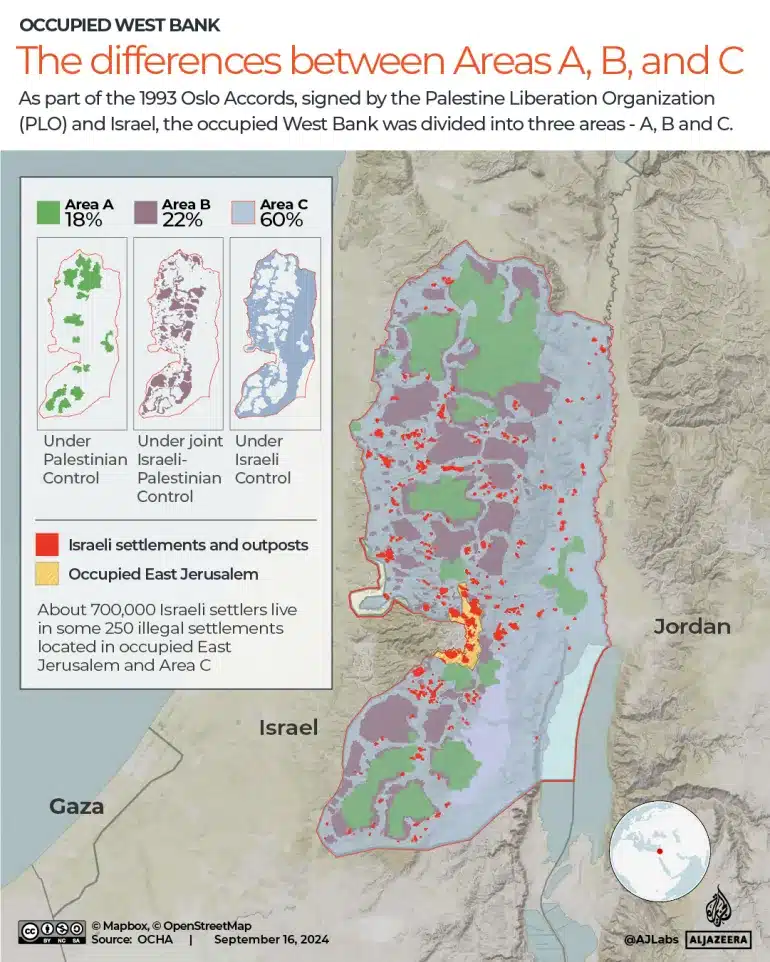
THE MEANING OF AREAS A, B AND C
The places where ISM engages in solidarity presence are made up mostly of area C, which is under full Israeli control, with some parts B and A. Below is a map, made by OCHA and shared from Al Jazeera, which explains what these different areas mean. Each geographic region has a different ratio of Area C, e.g. Jordan Valley is 90% area C but 10% is area B and A.
This map can also be viewed at this page: Al Jazeera
As violence escalates to record levels, Palestinians are asking for international activists to join them in their struggle for freedom and justice.
The International Solidarity Movement (ISM) is a Palestinian-led movement committed to resisting the long-entrenched systematic oppression and ongoing dispossession of the Palestinian people, using non-violent direct-action means. We show up as a solidarity presence with children going to school, farmers working their land, and families resisting the destruction of their homes. With our photos, videos and writing, we also document the daily reality under occupation and its numerous human rights abuses.
We work collaboratively, sharing decision-making power and a commitment to anti-oppression principles.
If you’re interested in joining us, please visit: ISM