
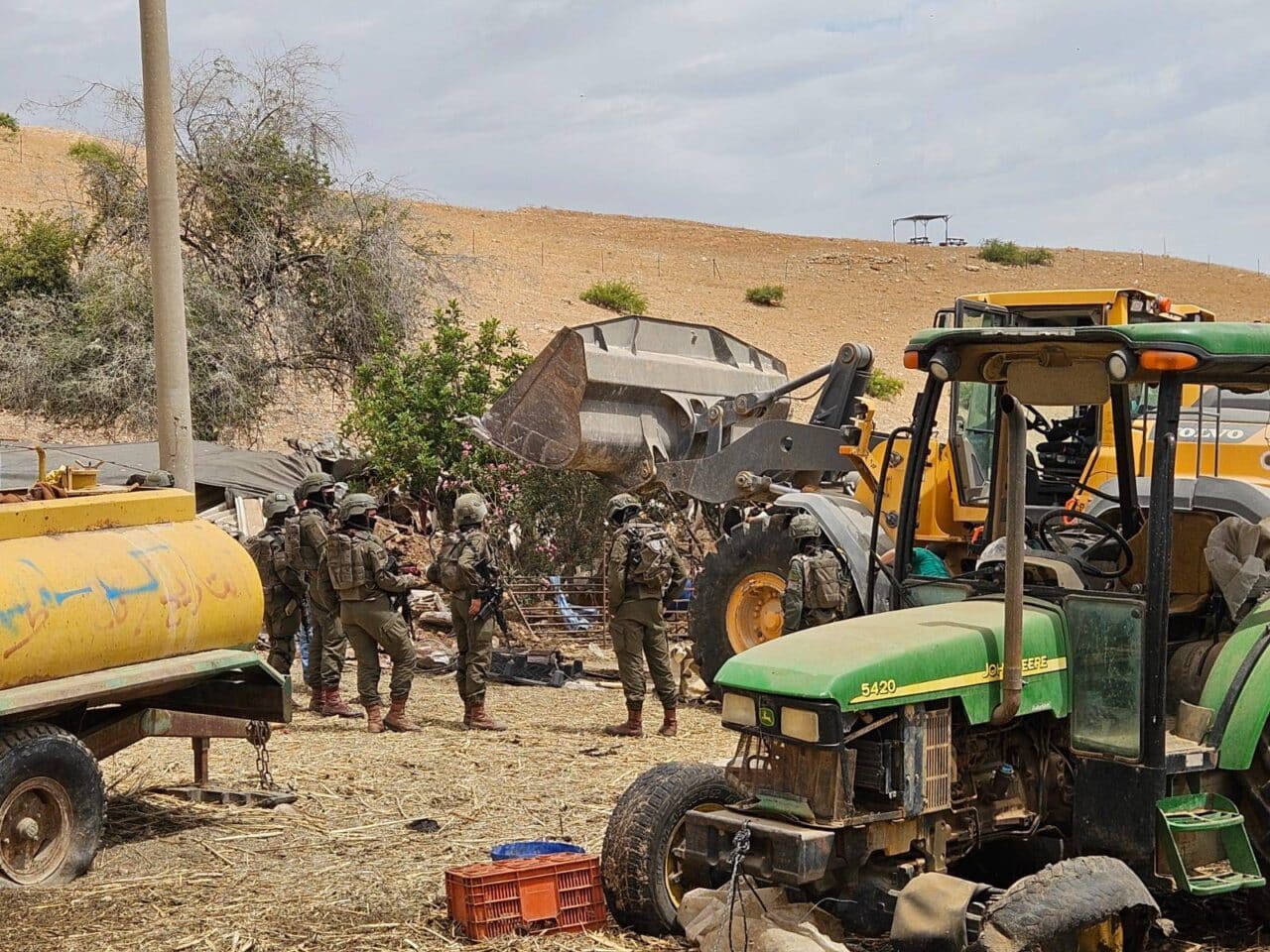
May 20, 2026 – The Israeli Civil Administration, together with the Israeli military and Border Police, began demolition operations this morning in the community of Ein al-Hilweh in the northern Jordan Valley. At approximately 10 a.m., bulldozers accompanied by military vehicles entered the community to demolish the homes of Adel and Fathi Daraghmeh. According to the families’ lawyer, the Israeli military command ignored an official address he submitted regarding the demolition orders on April 20, 2026.
Part of Adel Darghmeh’s residential compound, including animal sheds, was demolished today. At Fathi Darghmeh’s home, the Civil Administration issued a new “stop-work order”, summoning the family to a hearing scheduled for June 10, 2026.
A few hours after the demolition, the Israeli military, accompanied by settler Shai Eigner, prevented the Red Crescent emergency relief workers from unloading a tent and other equipment for the Daraghmeh family Ein al-Hilwe. The soldiers then instructed the Red Crescent driver to follow them and escorted the vehicle to the settlement of Brosh Habik’a.
These demolitions took place amid ongoing pressure and intimidation against Palestinian communities in the northern Jordan Valley. Ein al-Hilweh is the last remaining community along Road 5799, the only road directly connecting the northern Jordan Valley to Tubas. The communities of Hammamat al-Maleh, Hammamat al-Miteh, and Hammamat al-Burj were forcibly displaced at the beginning of 2026.
According to the projected route of the Crimson Thread, an Israeli infrastructure project launched in August 2025 to construct a 500-kilometer barrier through the northern Jordan Valley, the area is expected to be cleared of Palestinians in preparation for the barrier’s construction. The barrier, planned to connect the new Ein Shibli checkpoint to the Tayasir checkpoint, is set to pass across Road 5799, and is aimed at isolating Palestinian communities from their agricultural lands while strengthening territorial continuity between Israeli settler outposts in the northern Jordan Valley.
On February 8, 2026, Israeli forces and Border Police demolished the home of Fatima Darghmeh in Ein al-Hilweh, where she had lived for 50 years. Bulldozers completely flattened the house and destroyed water containers, solar panels, a generator, and a bathroom structure.
Earlier this year, on March 8, Colonel Gilad Shriki, commander of the Jordan Valley Brigade and a resident of the settlement of Gitit, toured several Palestinian communities in the northern Jordan Valley, including Samra, Khalet Makhul, Hammamat al-Maleh, Ein al-Hilweh, and Farisiya Nab’at al-Ghazal. Accompanied by a Civil Administration officer, Shriki threatened residents with expulsion, stating that the communities were located within a military firing zone in Area C and would be cleared within “a year or two”.
Shriki also alluded to settler violence by suggesting that residents should leave and relocate to the towns of Tubas or Tayasir in order to avoid the hardship of remaining.
Shriki’s visits, carried out alongside a Civil Administration officer, highlight the systemic cooperation between Israel’s bureaucracy, its official armed forces, and armed settler groups operating in the area. These combined pressures, including demolitions, movement restrictions, military operations, and settler violence, were part of a broader effort to displace Palestinian communities from the northern Jordan Valley.
Photo and videos credit to family and solidarity activists